
This guide explains how to track Digioh campaign form submissions as conversions in Google Ads.
By adding a small JavaScript snippet to Digioh Custom Javascript, you can fire a Google Ads conversion pixel whenever a visitor submits a campaign form.
This approach is useful when:
-
You want to measure Digioh form submissions as Google Ads conversions
-
You are not using Google Tag Manager
-
You want conversions to fire only when a Digioh form is successfully submitted
Prerequisites
Before starting, make sure you have:
-
A Google Ads account
-
A Google Ads conversion action already created
-
Access to your Digioh account
-
The Google Ads conversion tracking URL
Step 1: Get Your Google Ads Conversion Tracking URL
-
Log into Google Ads.
-
Navigate to:
Tools & Settings → Conversions
-
Select the conversion action you want to track.
-
Choose Set up using a tag.
-
Locate the conversion tracking URL inside the event snippet.
It will look similar to:
Copy this URL — you will use it in the Digioh script.
Part 2: Add Your Tracking Code to the JavaScript Editor
Hover over your name in the upper-right corner of Digioh, then select Custom JavaScript.
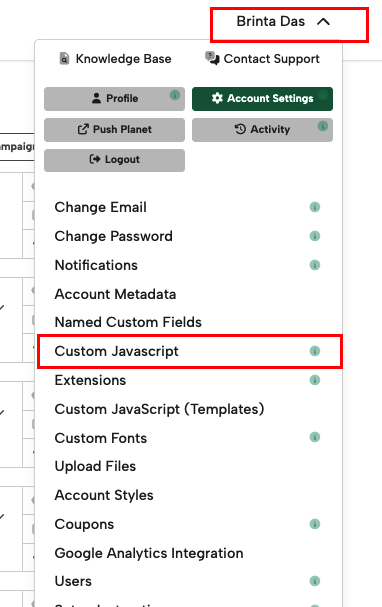
In the Custom JavaScript editor, create a new script that runs after a form is submitted.
Paste the following code:
var b = window.parent.document.createElement("img");
b.width = 1;
b.height = 1;
b.src = "GOOGLE_ADS_CONVERSION_URL";
Replace:
with your Google Ads conversion tracking URL.
Note that using window.parent.document is important. This writes the tracking pixel into the parent to ensure that it has time to fire, even if you configure the Campaign to close immediately after form submission.
Step 4: Specify the Campaigns to Track
In the Custom JavaScript configuration:
- Set the event trigger to After Submit
- Enter the Digioh campaign IDs for the campaigns you want to track.
- You can find the Campaign ID in the main campaign list in Digioh.
When you’re done, your code should look like this:

Step 5: Save and Publish
-
Click Save.
-
Click Publish to push the changes live.
Your Google Ads conversion tracking is now active.