
Overview
Digioh Passport for Iterable connects your Digioh on-site campaigns with your Iterable user data. Once enabled, Digioh can recognize visitors who already exist in Iterable, sync a visitor’s identity to Iterable after a Digioh form submission, and use profile data to control when specific on-site experiences appear – all without requiring additional forms or custom development.
Once enabled, Digioh can:
- Identify visitors who already exist in Iterable
- Sync a visitor’s identity to Iterable after a Digioh form submission
- Identify users clicking through from Iterable emails
- Distinguish between known and unknown visitors
- Use Iterable profile fields and list membership to control Digioh display rules
- Personalize on-site messaging using Iterable data
- Track page view and campaign interaction events to Iterable
- Support cart abandonment, browse abandonment, and cross-device identification
What Makes a Visitor “Known”?
Digioh considers a visitor “known” if any of the following has occurred:
- Digioh collected their email earlier on that device (via a campaign form submission)
- They arrived at your site via a link in an Iterable email that is configured to pass identity on the query string
- A JavaScript variable is configured to expose their email or user ID to Digioh
Prerequisites
Before setting up Passport, ensure the following are in place:
- An Iterable Server-Side API Key generated in Iterable
- The Digioh script installed on your website
- Google Analytics authenticated in your Digioh account (recommended, for revenue reporting)
Setup Instructions
Step 1: Connect Digioh to Iterable
You will need at least one authenticated Iterable integration configured in your Digioh account.
- In Iterable, generate a Server-Side API Key.
- In Digioh, go to Integrations and click Add Integration. Search for Iterable and select it.
- Click Add New Connection. Name your connection, enter your Iterable API Key, and select your Project Type (email, userId, or hybrid).
- For Restrict Profile Data: By default, Digioh restricts the dataFields that can be retrieved from a profile. Additional dataFields can be retrieved by adding them here. This page from our help docs has more info.
- Save the integration id: Note the 5-digit Integration ID shown on the Integrations page – you will need this in Step 3.
Step 2: Install the Passport Extension
- In Digioh, hover over your profile icon in the top right and select Extensions.
- Scroll to the Platform Interoperation section.
- Find Owned Identity for Iterable and click Install.
- Click Publish to Your Site to push the extension live.
Step 3: Add Account Metadata
This step links the extension to your Iterable integration.
- From the profile menu (top right), select Account Metadata.
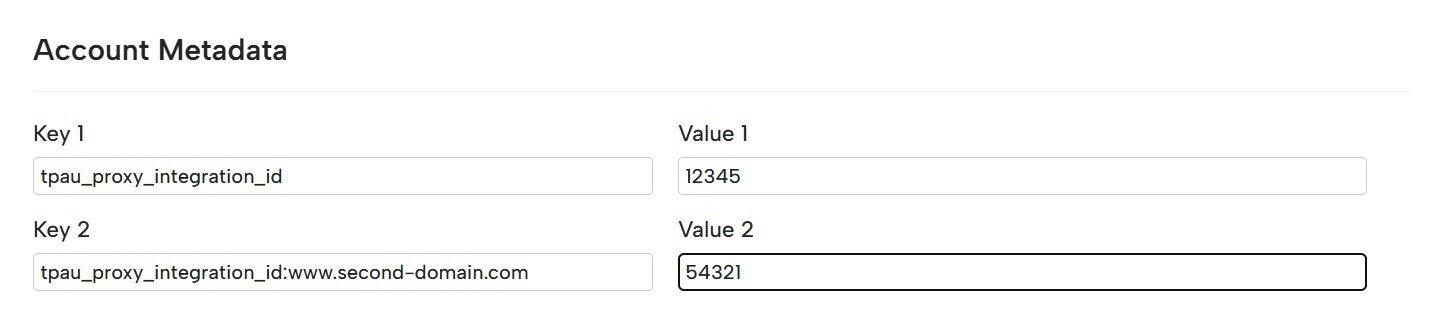
- Add the following key-value pair:
Key: tpau_proxy_integration_id
Value: [Your Iterable Integration ID from Step 1]
- Click Save, then go to Campaigns and select More > Publish Account.
Once this is complete, Passport for Iterable becomes active on your site.
For multiple sites or sandbox environments using different Iterable integrations, add a site-specific override:
Key: tpau_proxy_integration_id:www.staging.yoursite.com
Value: [Sandbox Iterable Integration ID]
Use the full exact domain including “www.” when specifying site-specific overrides.
Step 4: Maximize Identity Tracking (Optional but Recommended)
Digioh will automatically retain and use the email identity of visitors who submit a Digioh campaign form. To expand identification coverage to your broader subscriber base, we recommend the following.
Email Click-Through Identification
Update your Iterable email templates so that links to your site include the user’s identity on the URL query string, using Iterable’s Handlebars syntax:
?email={{email}}
?userId={{userId}}
We recommend using userId where possible (if you have a userId Iterable project) as it is more secure. Add these parameters to the links in your highest-traffic emails – especially welcome and double opt-in emails – to maximize the reach of identity tracking across your subscriber base.
Iterable JavaScript SDK
If you have configured the Iterable JavaScript SDK and are using the Link Tracking Domain feature, Digioh will automatically read the email or userId from it if available. No additional configuration is required.
JavaScript Variable
If your site exposes a logged-in user’s email or ID in a JavaScript variable, add the following to Account Metadata:
Key: tpau_userid_source_var
Value: window.yourDataLayer.customer_id (or whichever JS path exposes the ID)
Using Passport in Digioh Campaigns
Targeting Known Status and List Membership
After installing the extension and configuring Account Metadata, Iterable-specific targeting rules become available in Campaign Display Rules. The available built-in rules are:
- Visitor Known to Iterable – whether the current visitor has a known Iterable profile
- Visitor in Iterable List – target or suppress campaigns based on static list membership
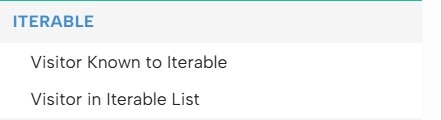
Known visitors are people Digioh can already match to an Iterable profile. Use this to suppress email capture pop-ups or show “welcome back” and loyalty messaging. Unknown visitors are people Digioh has not yet identified. Use this to show welcome sign-ups, first-time offers, or newsletter promotions.
Note: Dynamic Lists (Segments) are not supported at this time, as the Iterable API does not support per-user Dynamic List membership lookups.
Targeting User Profile Fields, including messageType and Channel Subscriptions (Advanced)
Iterable user profile fields are exposed via the DIGIOH_API.itrbl JavaScript object and can be used in Campaign display rules:
DIGIOH_API.itrbl.attributeName
Example: to target visitors whose favoriteColor attribute equals “green”:
JavaScript Variable | Equals | DIGIOH_API.itrbl.favoriteColor | green

Digioh can also create Custom Display Rules based on these fields to make targeting easier for non-technical users. Contact Support to request this.
When anti-targeting on a profile field, always combine with a “known” check:
Iterable Identity | known
JavaScript Variable | Does NOT equal | DIGIOH_API.itrbl.favoriteColor | green

Without the “known” check, the campaign would also show to all unknown visitors (for whom the attribute is undefined, which does not equal the value).
You can also target campaigns based on a user’s subscription status to specific messageTypes or Channels in Iterable.
To create rules based around your opt-out messageTypes in Iterable, use the JavaScript variable:
DIGIOH_API.itrbl.unsubscribedMessageTypeIds

To create rules based around your opt-in messageTypes in Iterable, use the JavaScript variable:
DIGIOH_API.itrbl.subscribedMessageTypeIds

To create rules based around your channels in Iterable, use the JavaScript variable:
DIGIOH_API.itrbl.unsubscribedChannelIds

Note: By default, users in Iterable are subscribed to channels. Iterable only tracks the IDs for channels that a user has unsubscribed from.
Personalizing Campaign Content
Install the Universal Merge Tags extension alongside Passport, then use the following syntax in campaign text to populate Iterable profile field values:
[ITERABLE_FIELD|fieldName|default_value]
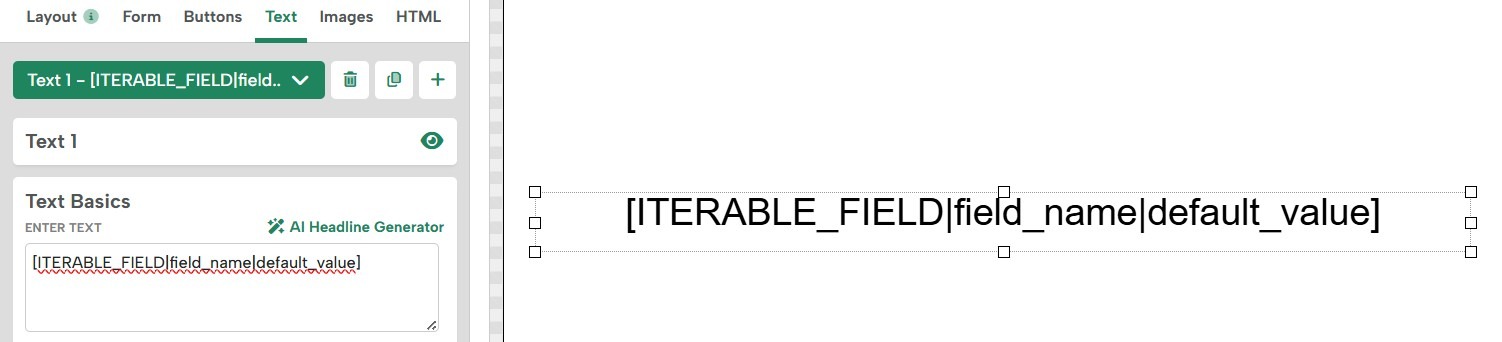
The default_value is optional but recommended. It is used when the visitor is unknown, the field does not exist in their Iterable profile, or the field is blank.
We recommend conditioning any campaign that uses merge tags on DIGIOH_API.itrbl.known = true, so that personalized content only appears for identified visitors.
Tracking Events to Iterable
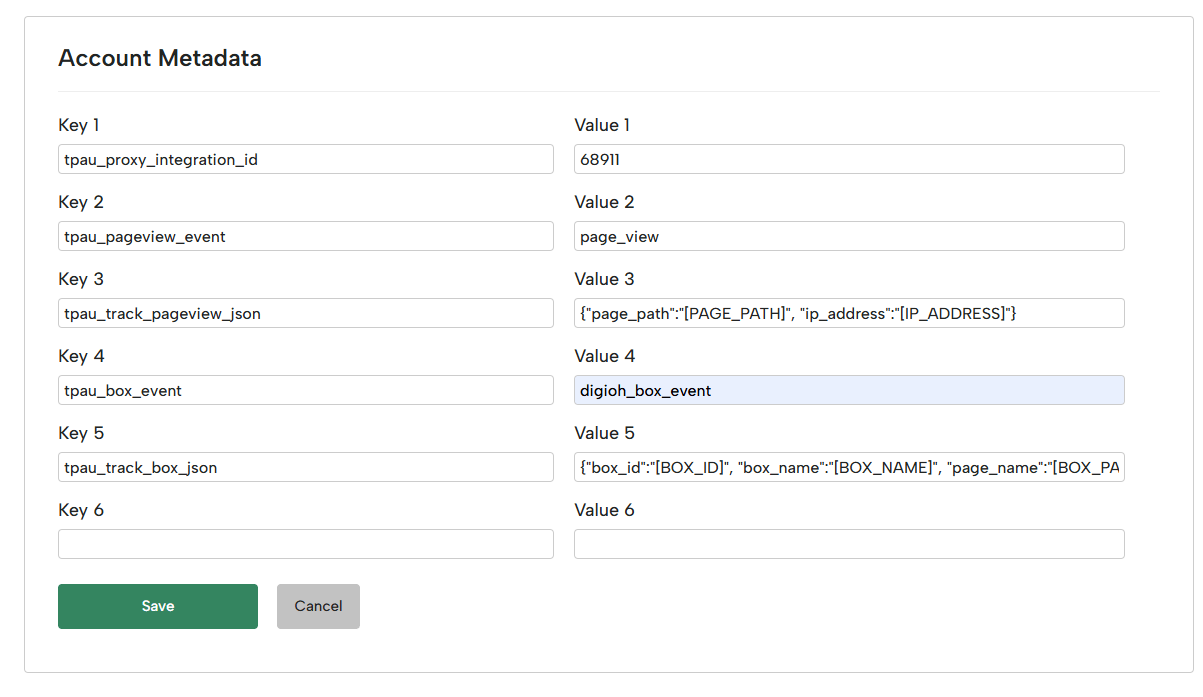
The extension can be configured to track page view and campaign events to Iterable using metadata at the account, campaign, or campaign-page level.
Available Metadata Keys
tpau_pageview_event: Name of the Iterable event to send on every page view. Configured in Account Metadata.
tpau_track_pageview_json: JSON for the event payload, supporting UMT merge tags. Example: {“page_path”:”[PAGE_PATH]”, “ip_address”:”[IP_ADDRESS]”}
tpau_box_event: Name of the event to send when a campaign page is viewed.
tpau_track_box_json: JSON for the campaign event payload. Example: {“box_id”:”[BOX_ID]”, “box_name”:”[BOX_NAME]”, “page_name”:”[BOX_PAGE]”}
Important: As of September 2023, Iterable requires that custom event names and properties be pre-created in Iterable before sending. Without this, Iterable will ignore events sent by Digioh.
The extension tracks the most specific event level configured. If both campaign-page-level and campaign-level config exist, only the campaign-page event is tracked.
Skipping the Email Collection Page for Known Users
When using Digioh Passport for Iterable, you can automatically skip an email collection page in a multi-step campaign if the visitor is already known to Digioh and Iterable. This is useful for quizzes or surveys where returning users should not be asked for their email again.
How to Configure
- Identify the campaign page that collects email (it must have a form with the Email field enabled).
- Add a page-level metadata entry to that page:
Key: when_exists
Value: [page to skip to, e.g. ep6 or thx]
Note: This does not auto-submit the form. It simply skips the specified page for known visitors.
Advanced: Interoperating with Your Site JavaScript
From your own on-site JavaScript or a Google Tag Manager tag, you can call the functions listed below from the window.DIGIOH_API object for advanced use cases.
Please note: You should only attempt to do this if you are comfortable developing custom JavaScript or have technical resources to assist.
- DIGIOH_API.setIterableEmail(email): set or replace the known user profile with an email
- DIGIOH_API.setIterableUserId(userId): set or replace the known user profile with a userId
- DIGIOH_API.clearIterableData(): remove all known user info and make the visitor unknown
- DIGIOH_API.trackIterableEvent(eventName, payloadObj, options): track a custom event to Iterable, or queue it if the user is unknown. Options include updateEventId and createdAt.
- DIGIOH_API.createOrUpdateIterableEmail(email, {optional: “fields”}): upsert a new email in Iterable, optionally setting user profile fields
Because Digioh is dynamically loaded JavaScript, these functions may not be available immediately on page view. To call them before Digioh has loaded, use the event queue:
window.digiohEventQueue = window.digiohEventQueue || [];
window.digiohEventQueue.push({eventName: “preload_test_event”, eventPayload: {event_val: 1}});
Any events pushed to window.digiohEventQueue will be processed as soon as Digioh activates.
Getting Started Checklist
- Iterable account set up and configured
- Iterable connection created in Digioh
- Passport extension installed and published
- Targeting and personalization rules created for relevant campaigns
- Test completed using ?boxqamode on your site
For questions or assistance, contact the Digioh support team at support@digioh.com.